What To Know Before Buying Land Near Farragut
June 11, 2026
June 11, 2026
Thinking about buying land near Farragut? A beautiful piece of acreage can look like the perfect blank canvas, but the real story is usually in the details. Before you fall in love with a lot, you need to know whether it can actually be accessed, served by utilities, and approved for the kind of build you have in mind. Let’s dive in.
One of the biggest mistakes land buyers make is assuming “near Farragut” means one set of rules applies everywhere. In reality, a parcel inside Farragut’s corporate limits may follow a different planning, permitting, and utility process than a property just outside town.
That distinction matters because nearby areas can fall under different county or city systems. If a lot is outside Farragut, it could involve Loudon County or other local utility structures, which may change your timeline, costs, and development options.
For parcels inside Farragut, the Town’s Planning & Zoning, Engineering, and Building & Fire Codes teams handle permits, planning review, inspections, and related requests through MyGovernmentOnline. That makes the Town your first stop for understanding what can be built and what approvals may be required.
If the land sits outside Farragut, you need to verify the correct local authority right away. For example, Loudon County Planning & Codes handles planning, zoning, and development for unincorporated Loudon County and certain nearby cities, while LCUB serves Lenoir City and the immediate surrounding area for water and wastewater.
Bottom line: never assume two nearby parcels will follow the same process just because they share a Farragut mailing address or feel close on a map.
Utilities can quickly separate a promising lot from a frustrating one. In the Farragut and west Knox area, First Utility District of Knox County serves a broad area, but buyers should confirm whether a specific parcel is actually inside that service territory.
If the lot is within First Utility District boundaries and you plan new development, the first step is a Service Availability Request. The utility says its engineers review whether enough water and sewer capacity exists, and that process usually takes about two weeks.
That early check can save you time and money. Utility easements, design details, and plan submittals may all affect whether your project moves forward smoothly.
Not every lot has access to public sewer. If the parcel will need a septic system, Tennessee requires a Septic System Construction Permit.
That application includes basic site information such as lot size, bedroom count, expected occupancy, a rough sketch of the property, and locations for the house site, driveway, utilities, and any well or spring. Depending on the site, soil maps or engineered design may also be required.
The Tennessee Department of Environment and Conservation says review generally takes about 10 days and must be completed within 45 days. The Tennessee Department of Health also notes that soil conditions and site characteristics help determine the right system design, which is why septic feasibility should be checked before you commit to a lot.
Online parcel maps are useful, but they are not a substitute for a survey. The Knox County Property Assessor says KGIS can help with general property lines, but an exact boundary requires a survey.
That matters more than many buyers expect. A survey helps you confirm where the lot begins and ends, whether improvements are in the right place, and whether access, easements, or right-of-way issues may affect your plans.
Farragut also points out that a survey is the best way to avoid future problems. If you are buying land for a custom home or long-term investment, this is one step worth taking seriously.
A lot is only as usable as its access. Before you buy, make sure you understand how you legally reach the property and whether your planned driveway location will be allowed.
In Farragut, driveways and other access points onto non-local streets require approval through the Planning Commission and Board of Mayor and Aldermen. That means road frontage alone does not automatically guarantee simple access.
You should also review any utility, drainage, or platted easements tied to the parcel. Farragut notes that fences placed in utility or drainage easements can be removed without re-installation, and retaining walls generally cannot sit in the right-of-way or in platted easements unless authorized.
Those examples are a good reminder that easements can limit where you place improvements. Even if you are only buying vacant land today, future plans for fencing, grading, driveways, or site layout may all be affected.
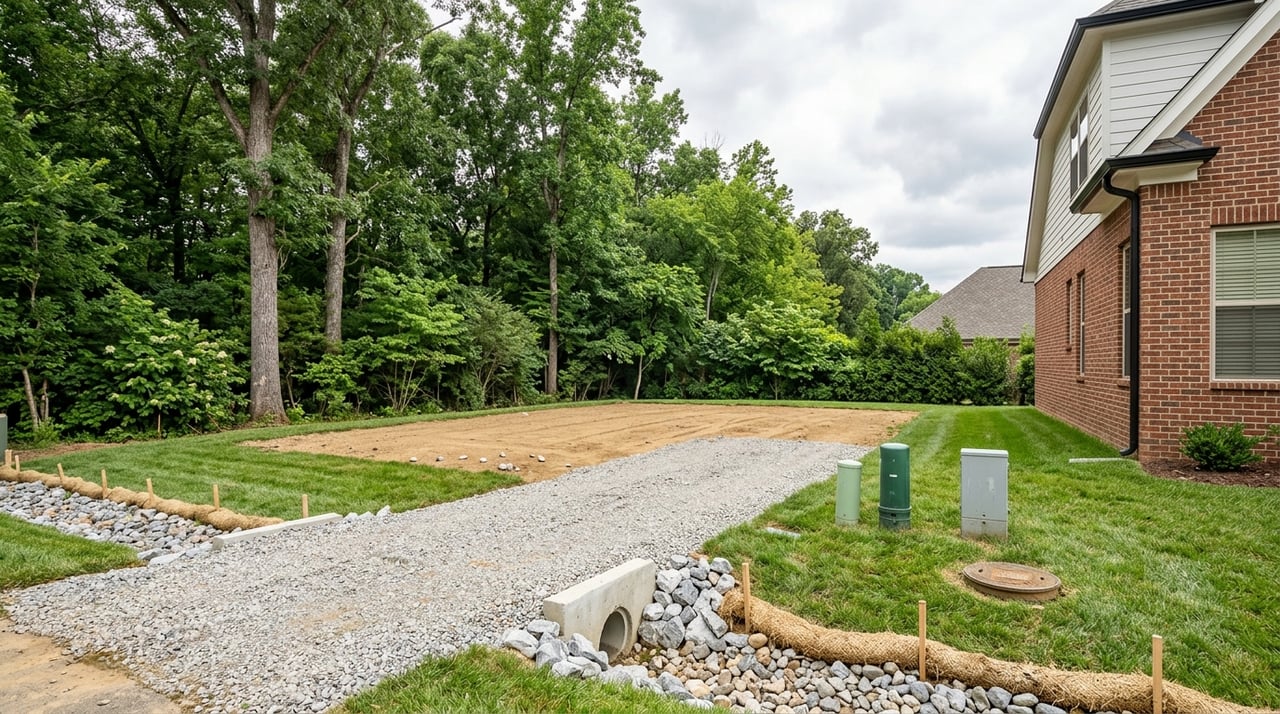
Some land issues are easy to see, while others show up later during planning and construction. Drainage is one of the most important examples.
If you are considering sloped land, creek-adjacent property, or a lot with wet areas, you should treat drainage as a major due-diligence item. In Farragut, the Engineering Department reviews subdivision plats and public infrastructure such as streets and drainage systems, and the Town also administers floodplain management regulations.
Farragut’s drainage policy also states that private owners are responsible for drainage features on their own land rather than on public rights-of-way. In practical terms, that means water movement on the property is not just a cosmetic issue. It can affect grading, site design, approvals, and long-term maintenance.
Many buyers assume they can clear brush, move dirt, or rough grade a lot soon after closing. That can be a costly assumption.
Farragut requires a grading permit when a site plan or preliminary plat is required. If your goal is to build, divide land, or significantly improve the parcel, you should confirm whether grading review applies before any work begins.
Stormwater rules can also come into play. If construction will disturb one acre or more, Tennessee’s construction stormwater permit applies, adding another layer to the planning process.
A parcel can look buildable at first glance and still require several different approvals. One of the most important things to understand is that zoning approval, building permits, and utility or septic approvals are separate questions.
Farragut’s zoning rules may apply to lot coverage, sidewalks, driveways, certain fences, and retaining walls, including some improvements that do not require a building permit. The Town also notes that zoning ordinances set density and housing type by district, and site plans for new subdivisions must be approved.
Building permits are a separate step. Farragut says new construction and many structural or system-related changes require permits through MyGovernmentOnline, and once a complete application is accepted, initial review typically takes up to 20 business days for most residential and commercial projects.
That is why a quick “Can I build here?” question often needs a more detailed answer. A better question is: What approvals will this specific parcel need for my specific plan?
If you are looking at a larger tract near Farragut, property tax classification may be worth reviewing early. In Knox County, the Greenbelt program can apply to qualifying agricultural land, forest land, or open space.
According to the Knox County Property Assessor, agricultural and forest land generally must be at least 15 acres, while open space must be at least 3 acres. Qualifying land is taxed based on present use rather than highest and best use.
This will not apply to every buyer, and tax savings can vary. Still, for acreage purchases, it is one more reason to understand the parcel’s current status and future use before closing.
Buying land usually requires more early investigation than buying an existing home. The good news is that the right local contacts can help you get clear answers before you move forward.
For land near Farragut, the most useful early contacts may include:
This is also where local real estate guidance can make a big difference. When you are evaluating land, you are not just buying a property. You are buying a process, a timeline, and a set of development possibilities.
The best land buyers are not the ones who move fastest. They are the ones who verify the basics before they commit.
If you are considering land near Farragut, focus first on jurisdiction, utility availability, access, easements, drainage, grading rules, and build approvals. Those are the issues most likely to affect whether the lot fits your goals.
With the right due diligence upfront, you can move forward with much more confidence and avoid expensive surprises later. If you want local guidance on evaluating acreage, homesites, or investment property in Farragut and the greater Knoxville area, connect with Seth Jenkins for practical advice tailored to your search.
Stay up to date on the latest real estate trends.


Whether buying or selling, Seth delivers a tailored, hands-on approach designed to achieve your goals with confidence.